
Evolution of the Shortlist: From Bi-Fold to Blog

In the very first issue of SMPS SFBAC's newsletter, The Short List, back in winter 1986, columnist Margaret Spaulding set forth this call to action:
Newsletters strongly resemble the organizations they represent: you get out what you put in... Make this your newsletter: tell the esteemed editor everything you can… contribute items about your firm and your colleagues, volunteer new ideas (or old ones), offer to write articles (look, if I can do it, anybody can).
Spaulding, one of the seminal members of SMPS SFBAC, received a degree in journalism from U.C. Berkeley and marketed for architectural and engineering firms for decades. She envisioned a publication offering “real news” that would have readers eagerly awaiting its next issue.
Thirty-two years on, the format has changed and the name elided, but The Shortlist still aspires to must-read status.
We echo Spaulding’s original call: Make this your newsletter. Contribute. Volunteer. Write!
Contributing from here on out will be easier than ever, because (finally) The Shortlist is a blog! While the PDF format provided a beautiful layout (thanks to the talented Christine Luong), it didn’t give us access to analytics. Many members weren’t sure where the PDF “lived,” and valuable content was often lost to the email avalanche.
So here we are, in the age of inbound marketing, setting our newsletter free. It’s digital, it’s all-access, it’s more timely than ever. To set the groundwork for our evolution, we scanned the print archives of The Shortlist and decided to highlight some of the content written by our predecessors. Reading through these archives proved that the more things change, the more they remain the same. Join us for an illuminating trip through time.
Volume 1, Number 2: Summer 1986
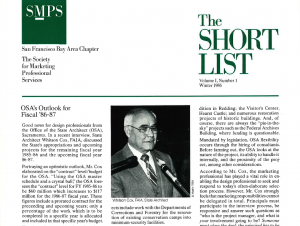
"SMPS kicked off its 1986 Luncheon Programs at the Sheraton Palace Hotel in San Francisco on April 17 with John L. Molinari, President of the San Francisco Board of Supervisors… The Supervisor discussed many of the issues concerning San Francisco today, including the South of Market development plan; the balance of San Francisco’s neighborhoods; the Embarcadero Freeway; Candlestick Park; and, yes, even the issue of public restrooms."
Volume 2, Number 1: Summer 1987
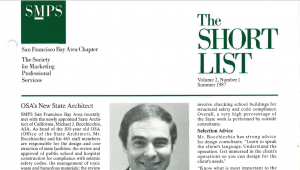
“Uncovering the Cover Letter,” by George S. Winnacker, President, MWM
"The cover letter is the first thing the selection committee reads and, let’s face it, the cover letter and the photographs may be the only things they look at the first time through. After all, they are trying to reduce that intimidating stack of proposals on their desks to a manageable dozen or so to study in detail."
Volume 2, Number 2: Fall 1987
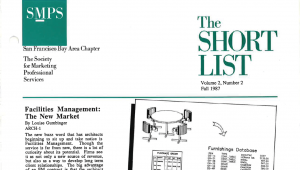
“Facilities Management: The New Market,” by Louise Gumbinger, ARCH-1
"The new buzz word that has architects beginning to sit up and take notice is Facilities Management. Though the service is far from new, there is a lot of curiosity about its potential. Firms see it as not only a new source of revenue, but also as a way to develop long term client relationships. The big advantage of an FM contract is that the architect can solidify repeat work through ongoing contact. When it is time for the next job, the firm will be in a preferred position to get it.
The emergence of CADD, Word Processing and Database Management has put FM into the realm of architecture. If there is a consensus that the architect is the natural manager of facilities data, then the potential for architects to provide FM services is tremendous. Smaller firms must develop an understanding of information structures and how to employ computer systems in data base applications."
Volume 4, Number 1: Winter 1989
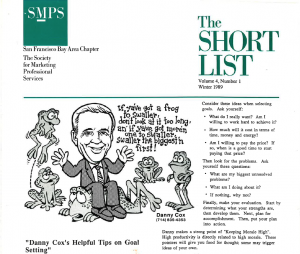
“Unsnarling the Bay Area,” by Linda Patterson
"A recent study of the Bay Area Council identified transportation as the #1 problem in the Bay Area today. People are finding that their old 30 minute commute now takes an hour. However, transportation is only a symptom of the real problem… Its cause is a local government framework that permits individual local solutions to regional problems. We accept difficult decisions only when they don’t affect us personally. The terms ‘NIMBY’ (not in my back yard) and ‘NIMEY’ (not in my election year were jokingly introduced at the recent General Assembly of the Association of Bay Area Governments (ABAG)."
Winter 1997
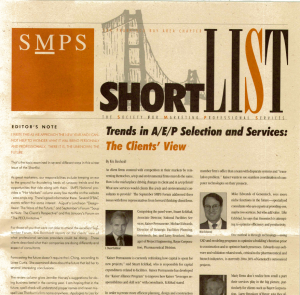
“Inventing the Future” by Loree Curtis
"The upcoming millennium has brought with it tremendous hype about what the next century will bring. What will life be like 10, 15 or 50 years down the road? Greg Schmid, a director at the non-profit Institute for the Future in Menlo Park, gave me a forecast for the next decade…
Proliferation of Information Technology. Two words: The Web. In the next few years, people will have more access to information than ever before Moreover, the number of people with access to PCs or PC-like devices will jump dramatically as cheaper formats will be available: the networked computer, the networked TV, smart telephones and game players.
Rise of a New Consumer. Schmid defined new consumers as being more educated and sophisticated. They demand more information before making purchases and are increasingly using technology to get that information. As occupations and extracurricular activities become more information intensive, this new consumer will have access to a wider range of products and services to choose from. According to Schmid, roughly 65% of people in the United States today are defined as the new consumer. In the next few years, that number will continue to increase at a greater rate."
Fall/Winter 1998

"Explaining the Marketing Animal: Its Origins, and Instructions on Care & Feeding,” Q&A with Kay Godwin and Sandy D’Elia
"Kay: So, Sandy, how has the marketer’s role changed in the last 20 years?
Sandy: The first marketing people I knew were basically sales people. They represented large engineering firms who had large institutional clients. Invariably, they were guys who were slick salesmen or women who were sales representatives. The women wouldn’t close deals; the guys would close the deals. …
I’ve seen the cycle go from the development of the new role called “marketing coordinator” to firms wanting marketing directors to firms questioning whether there even should be marketing directors. Now I see people are being hired again as marketing directors.
K: How are you defining marketing director?
S: Somebody who sets policy and strategy; develops long-range business plans; helps firms enter new markets; evaluates the quality of the markets they’re in and whether they’re growing or dying; and analyzes the competition — does that more strategic aspect of marketing.
My theory is that the initial interest in marketing — as opposed to just bird dogging or just being a sales rep — coincides with a social/philosophical change that was a result of what was going on in our country after WWII: the baby boomers, the population change, and the huge amount of prosperity that this country experienced in the 1960’s which could not continue. The end of that, symbolized by the oil crisis in 1973, caused some firms to rethink the way they were in business and start thinking about marketing for the first time."
 Traci Vogel is Content Manager at TEECOM, an international engineering consultant that prepares its clients for emerging technologies such as the Internet of Things, machine learning, and conversational interfaces. Visit TEECOM’s blog.


